The Founder’s Art Collection · Jabbi Delahaye

Visual
Intelligence

Where culture, imagination and intelligent innovation become visual form.

Ideas can be understood
before they are explained.

Visual Intelligence presents original artworks by Cultural Intelligence Studio founder Jabbi Delahaye. The collection explores how images can communicate complex ideas, preserve cultural memory, reveal connections and encourage new ways of seeing.

Drawing together symbolism, material imagination and emerging creative technologies, the work reflects the wider C.I.S. philosophy: human judgement at the centre, culture treated with depth, and innovation used purposefully.

The Architecture of
Cultural Intelligence

A visual expression of the philosophy, vision and mission behind Cultural Intelligence Studio.
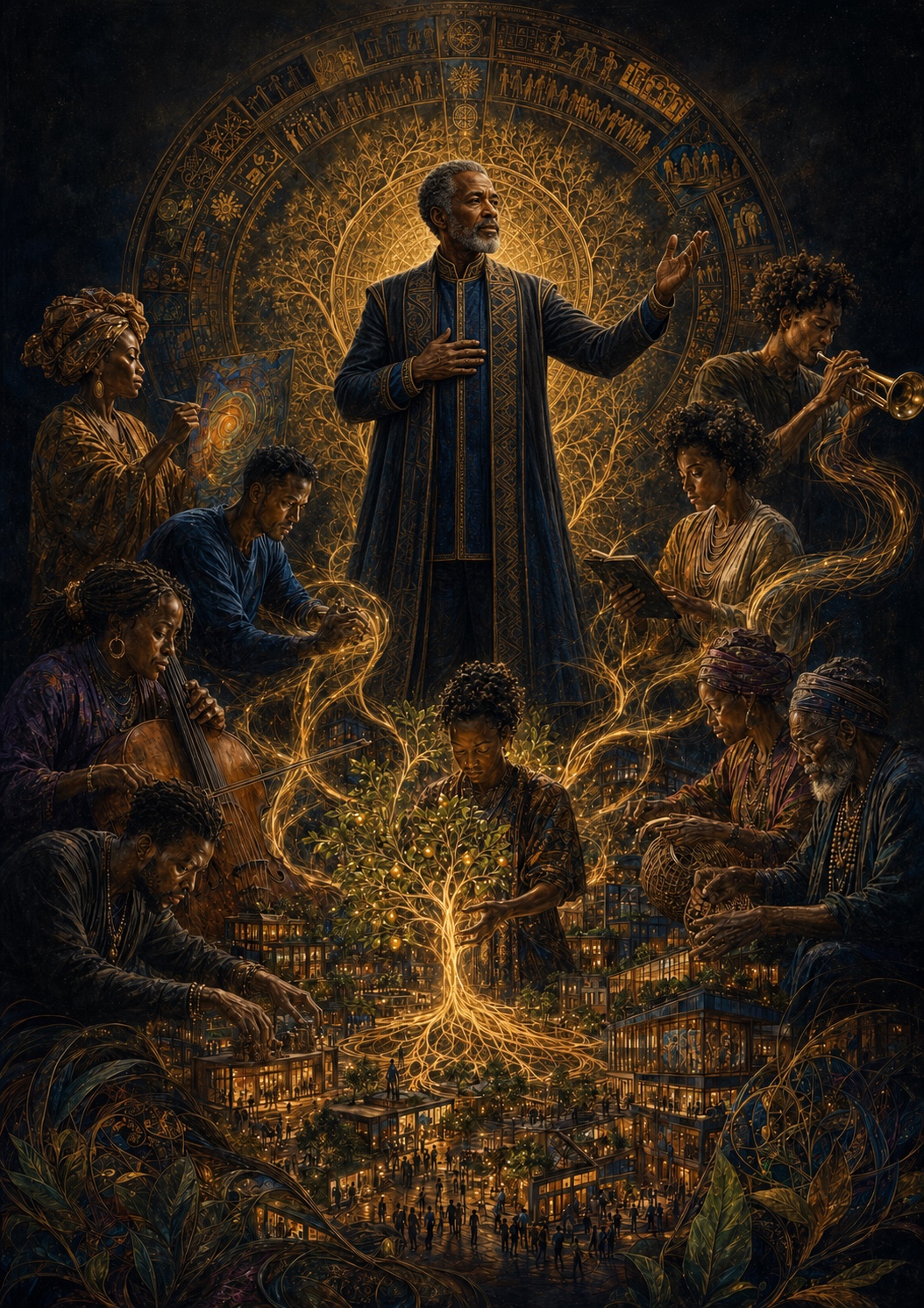
The Architecture of Cultural Intelligence by Jabbi Delahaye: a wise Black leader surrounded by artists, musicians, thinkers and makers whose ideas flow into a luminous tree and cultural district
Jabbi DelahayeDigital artwork · 2026

In creating this work, I wanted to capture C.I.S. not simply as a consultancy or creative business, but as a living space in which cultural knowledge, human imagination, strategic thinking and responsible technology come together. The composition moves from vision at the top to collective action, growth and tangible impact below.

The central figure represents wise, strong and purposeful leadership. His hand placed near his heart signifies integrity and responsibility, while his outward gesture communicates foresight, direction and openness to future possibilities. He does not stand apart from the surrounding community; he helps to connect and guide its collective intelligence.

Around him, artists, musicians, thinkers, makers, researchers and community knowledge-holders represent the people and perspectives that give culture its depth. Their individual contributions are joined by luminous lines, suggesting the movement of ideas, experience and creative energy across disciplines and generations.

At the centre of the lower composition, a radiant tree transforms this shared intelligence into growth. Its roots represent cultural memory, lived experience and community knowledge. Its illuminated trunk symbolises strategy and development, while its branches and golden fruit express creativity, opportunity and sustainable outcomes.

The cultural district emerging beneath the tree represents ideas made real: studios, enterprises, exhibitions, events, learning spaces and community initiatives. It reflects the C.I.S. mission to help promising ideas become clearer, stronger, more distinctive and capable of creating meaningful cultural, commercial and social value.

The circular structure behind the leader functions as a living archive—a symbolic meeting place for history, culture, creativity, ethics and future thinking. Technology is present only through subtle networks of connection. It supports human intelligence rather than replacing it.

Ultimately, the artwork presents Cultural Intelligence Studio as an ecosystem of possibility: a place where culture gives meaning, intelligence provides direction, creativity opens new possibilities and purposeful action produces lasting impact.
The Council of
Unseen Knowledge

An exploration of collective intelligence, cultural memory and the knowledge that conventional institutions have failed to recognise or record.

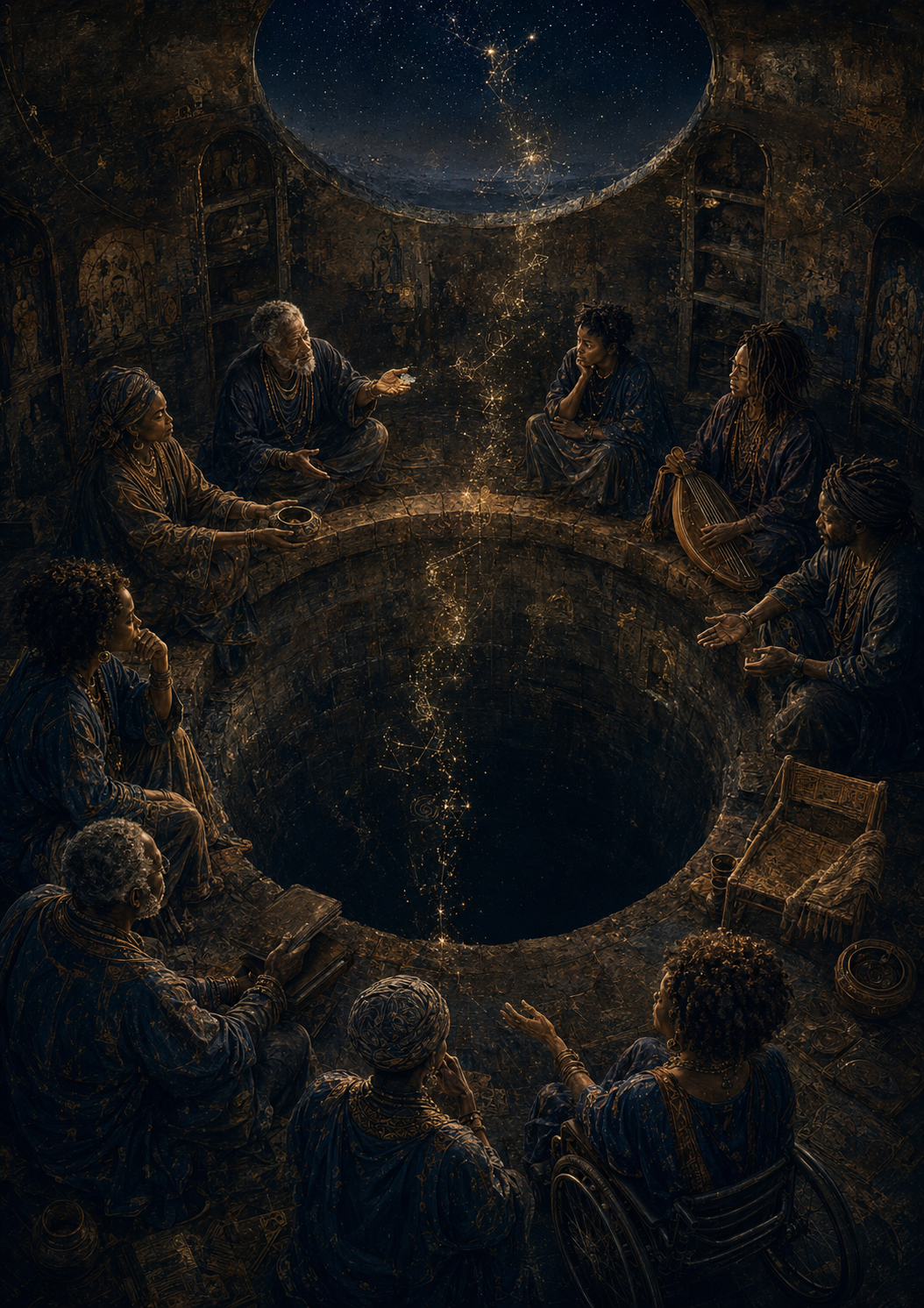
The Council of Unseen Knowledge by Jabbi Delahaye: an intergenerational council gathered around an abyss of forgotten knowledge beneath an open night sky
Jabbi DelahayeDigital artwork · 2026

The Council of Unseen Knowledge presents an intergenerational gathering positioned between two opposing infinities. Beneath the council lies a vast circular abyss containing cultural knowledge that has been overlooked, erased, suppressed or never formally documented. Above them, an opening to the night sky represents futures that have yet to be imagined.

A fragile golden current travels between these two spaces. Formed from traces of breath, fingerprints, sound, gesture, woven patterns and incomplete constellations, it symbolises knowledge moving through people and across generations. It is deliberately irregular and unfinished. No individual controls it, and no institution can claim ownership of it.

The council includes elders, artists, musicians, makers, researchers and younger knowledge-holders. Each contributes through a different form of intelligence. An elder shares an oral memory. A young person listens. A musician rests a hand upon an instrument. A maker offers a vessel shaped by human skill and inherited practice. A researcher closes a book, acknowledging that valuable knowledge exists beyond the written archive.

No single person presides over the gathering. Authority is distributed across the circle, expressing the principle that cultural intelligence is created through relationships, listening and the meeting of different forms of experience.

An empty chair introduces the presence of absence. Draped with a folded, handwoven textile, it represents voices lost to history, people excluded from recognised institutions and those whose knowledge remains unheard. It also leaves space for future participants—for perspectives that have not yet entered the conversation.

The surrounding chamber combines a community assembly, living archive and celestial observatory. Its worn surfaces, repaired fractures, sealed niches and partially erased images suggest that history is never complete. Archives preserve knowledge, but they also reveal what societies have chosen to value, neglect or forget.

Within the wider Visual Intelligence collection, the artwork reflects the Cultural Intelligence Studio philosophy that human insight must remain at the centre of innovation. Technology can extend capacity, reveal connections and support new possibilities, but it cannot replace cultural understanding, ethical judgement or the responsibility to listen.

The artwork ultimately asks whether an intelligent future can be created without first acknowledging what the past failed to record. It presents cultural intelligence not as something possessed by a single expert, but as a living inheritance—shared, contested and continually renewed through collective attention.

Can the future become culturally intelligent if it does not first listen to what history failed to record?

The Future Is Not
Inherited Whole

A meditation on cultural memory, interpretation and the collective architecture of possibility.

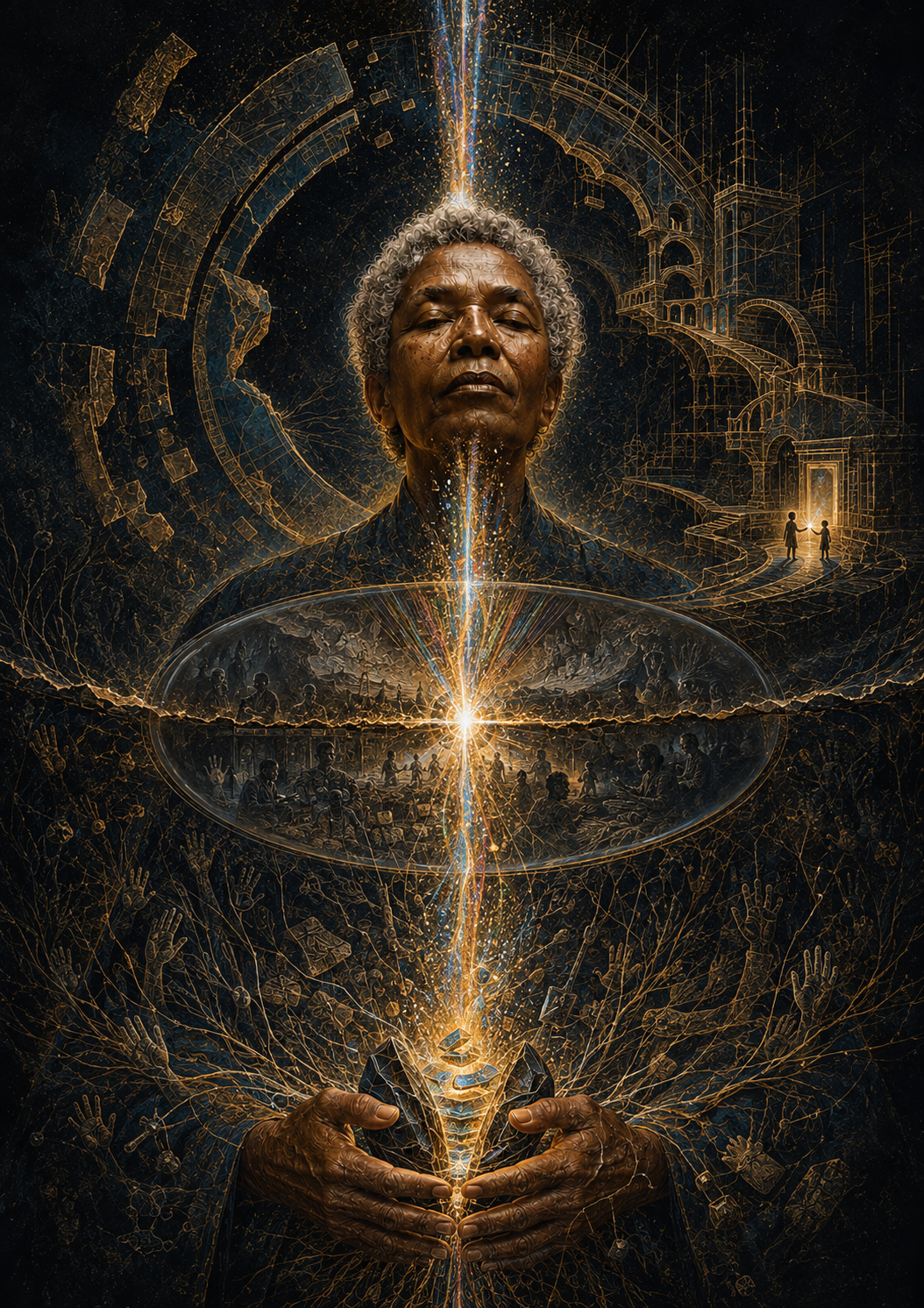
The Future Is Not Inherited Whole by Jabbi Delahaye: an elder holds an opening crystalline form as cultural memory passes through a luminous lens towards two young figures and an unfinished architecture
Jabbi DelahayeDigital artwork · 2026

The Future Is Not Inherited Whole explores cultural intelligence as a living process of inheritance, interpretation and collective transformation. At its centre stands an elder whose closed eyes suggest an attention directed beyond immediate appearances. The figure is neither ruler nor oracle, but a custodian: someone carrying knowledge shaped by lives, struggles and acts of imagination that came before.

Between the elder’s hands, a dark crystalline form opens to reveal an unfinished structure of gold and lapis. It can be read simultaneously as a seed, vessel, archive, idea or emerging building. Its ambiguity is essential. What one generation passes forward is never a complete blueprint for the next; it is material to be questioned, reinterpreted and made useful under new conditions.

Across the lower body, faint hands, roots, worn marks and fragments of human activity form a submerged archive. They acknowledge the knowledge carried through labour, oral memory, artistic practice, migration, care and community life—forms of intelligence that formal institutions have not always recognised or preserved. Their lines converge upon the open object, making clear that no future is the creation of a single visionary. It is assembled from countless contributions, including many whose names have been lost.

A vertical current rises from the opened form and passes through a wide, lens-like field at the elder’s heart. Within this lens, inherited experience is gathered, examined and transformed. The work rejects the idea that tradition must be repeated unchanged. Cultural continuity depends upon discernment: the ability to understand what should be protected, what must be repaired, what needs to be challenged and what can be remade.

The fractured circular archive behind the elder embodies incomplete histories and disrupted systems of knowledge. On one side, its weathered segments retain the traces of what has survived. On the other, those fragments begin to reorganise into an unfinished civic architecture. Memory becomes infrastructure: a bridge, forum, listening chamber and threshold through which cultural understanding can influence the institutions, enterprises and shared spaces of the future.

Two young figures approach the illuminated opening together. Neither is positioned as a solitary hero. Their presence expresses shared authorship and the responsibility of future generations to participate in shaping what comes next. The architecture remains deliberately incomplete because a culturally intelligent future cannot be predetermined. It must remain open to voices, experiences and possibilities that have not yet entered the frame.

The artwork’s material language reinforces its philosophy. Ultra-black fields evoke histories that remain obscured. Lapis suggests depth, knowledge and imaginative possibility. Cracked antique gold does not conceal rupture; it gives repair a visible presence. The luminous central axis binds ancestry, human judgement and future-making into one continuous movement, while the elder’s stillness holds the composition in a state of quiet authority.

Within the Cultural Intelligence Studio collection, the work reflects a central principle: technology and innovation are most valuable when guided by cultural understanding, ethical judgement and human purpose. Intelligence is not merely the accumulation of information. It is the capacity to listen across difference, recognise what conventional systems have overlooked, interpret complexity responsibly and turn understanding into meaningful action.

The future is not a finished inheritance. It is a shared responsibility—received in fragments, transformed through judgement and built together.
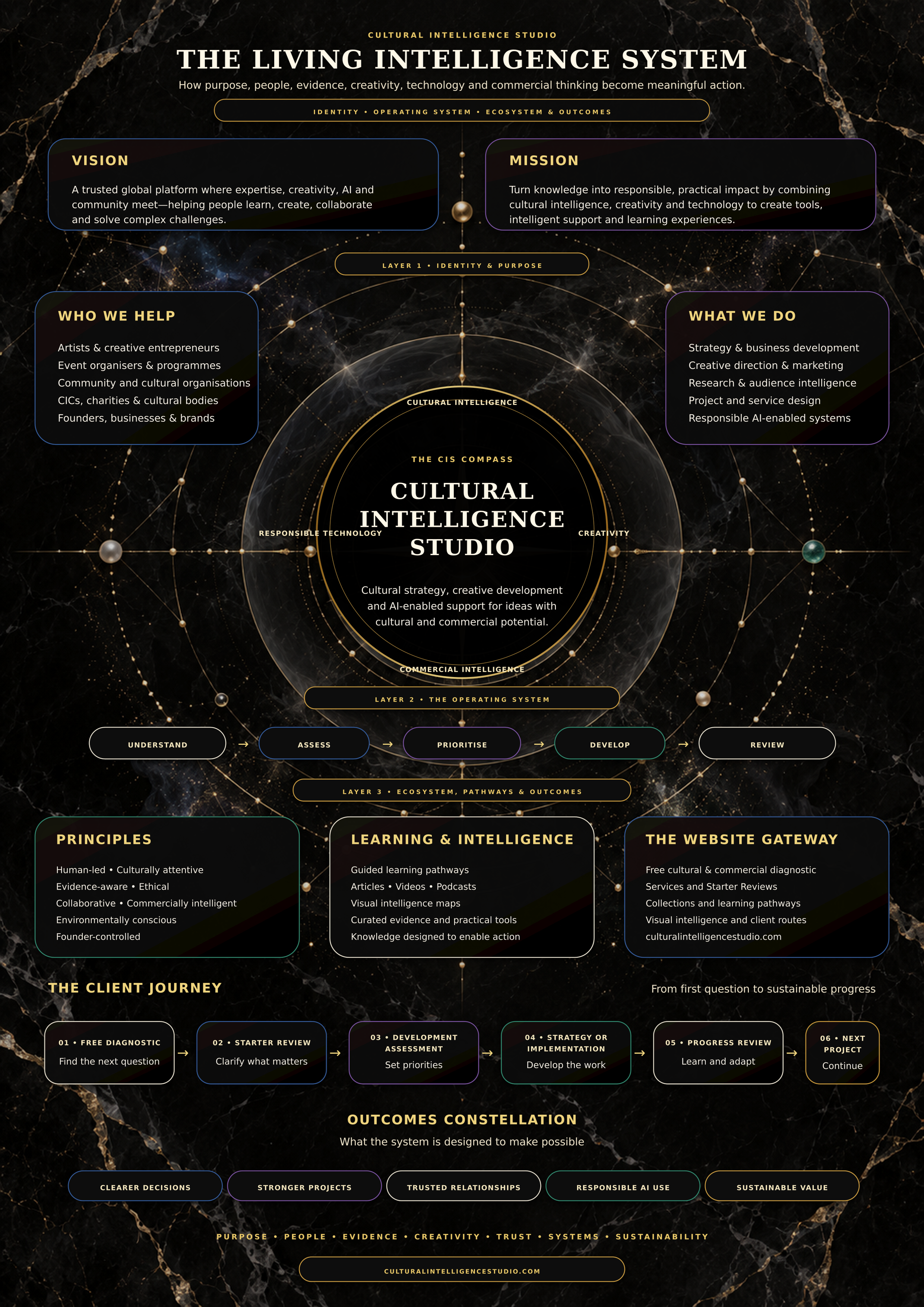
The Living Intelligence System infographic mapping the Cultural Intelligence Studio vision, mission, audiences, operating method, client journey, principles and outcomes

The Architecture of Cultural Intelligence:
Infographic Study

This companion work translates the symbolism of the original artwork into a practical visual account of the C.I.S. vision, mission and operating philosophy. It connects the C.I.S. Compass with the studio's audiences, five-stage method, client journey, governance principles, learning ecosystem and intended outcomes.

Presented here as part of Visual Intelligence, the study demonstrates how artistic thinking can clarify a living business system: image, information, interaction and strategy working together.

Explore the interactive map ↗

The ideas moving
through the work.

01

Culture & memory

Visual languages shaped by inheritance, identity, symbolism and the ways culture travels through time.

02

Intelligence & imagination

Art as a form of enquiry—making connections, holding complexity and revealing possibilities beyond literal explanation.

03

Human-led technology

Creative experimentation in which emerging tools expand artistic possibility while authorship and judgement remain human.

04

Transformation & possibility

Images concerned with becoming: the movement from an early idea towards clarity, strength and a new form.

Move from visual philosophy to practical intelligence.

Move from an idea to related knowledge, a practical service and a clear next action.

A growing visual record
of the C.I.S. philosophy.

Further works, individual artwork notes and collection details will be introduced as Visual Intelligence develops.

Enquire about the collection ↗