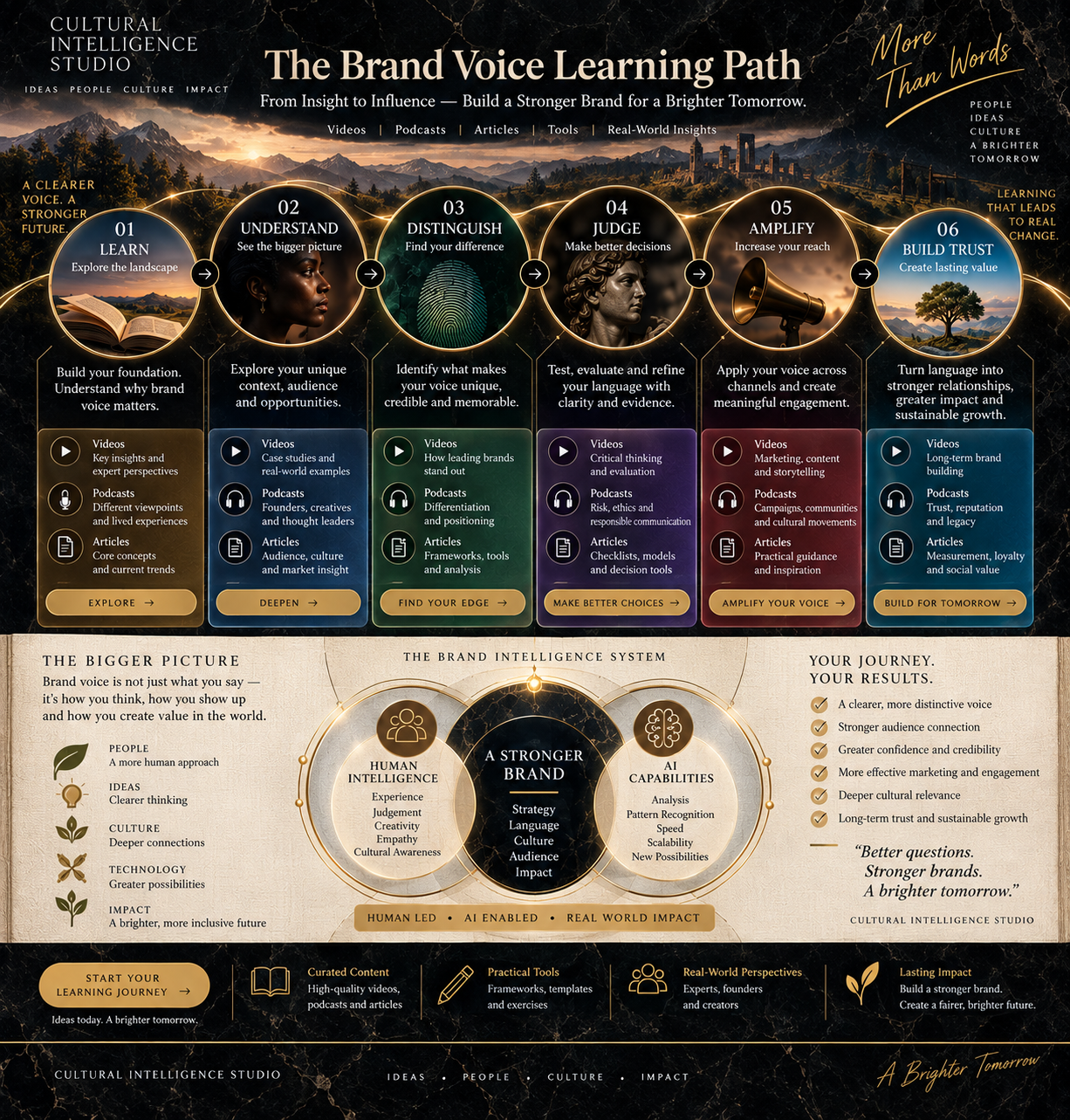
This is the designed infographic accompanying the pathway. Open it at full size to examine every stage, or enter the guided experience to work through the resources and build your own system.
How can an organisation become recognisable without reducing its identity to a tone-of-voice document?
By completing this pathway, you should be better able to:
Clarify identity before choosing style
Connect positioning with category and audience language
Examine culture, accessibility and power within communication
Develop assets that support recognition and memory
Separate meaningful difference from novelty
Give humans and AI systems shared evidence, principles and boundaries
How to use this pathway
Use one real organisation, project, programme or creative practice throughout. Follow the six stages in order. The pathway deliberately selects eight of the ten articles, two of the ten videos and five of the ten podcasts; the objective is depth and application, not completion for its own sake. Record each stage output before moving forward. Complete the route in one focused day, two half-days or one stage per week.
01
Stage 1 · 45–55 minutes
Begin with identity before expression
Start beneath tone and style. Clarify the origin, purpose and meaning that the language will need to carry before choosing how the organisation should sound.
What experience or unfinished possibility caused this organisation or project to begin?
What does it believe strongly enough to influence a decision?
Which promise must become visible in behaviour rather than merely language?
Practical exercise
Create an Identity Core Card. In no more than one page, record origin, purpose, the change the organisation seeks, three non-negotiable principles and one claim it is not yet ready to make.
Stage output: Identity Core Card
02
Stage 2 · 50–60 minutes
Find the position beneath the message
A distinctive voice cannot rescue confused positioning. Examine the alternatives, category assumptions and customer situations that make the organisation’s difference understandable.
What would people use if this organisation did not exist?
Which category claim has become too familiar to create preference?
In which situation should this organisation become the most relevant choice?
Practical exercise
Build a Position and Category Language Map with four columns: competitive alternatives, repeated category language, meaningful differences and phrases the organisation could credibly own.
Stage output: Position and Category Language Map
03
Stage 3 · 55–65 minutes
Understand audience language, culture and power
Move from the organisation’s preferred message to the language people already use. Examine context, identity, accessibility and who is expected to adapt before treating audience words as marketing material.
How do people describe the situation before they know the organisation’s terminology?
Whose language is treated as credible, and who must translate themselves?
What cultural or accessibility assumption needs investigation rather than confidence?
Practical exercise
Create an Audience and Cultural Context Map. Record one real situation, the language people use, what that language may mean, what remains uncertain, whose perspective is missing and how the organisation will learn without extracting.
Stage output: Audience and Cultural Context Map
04
Stage 4 · 80–90 minutes
Build recognition and memory
Difference is not useful if nobody can recognise or remember it. Explore how verbal, visual, intellectual and behavioural assets become attributable through repeated, coherent use.
Which existing phrase, question, format or behaviour is already associated with the organisation?
Could somebody recognise the communication before seeing the logo?
Which asset deserves consistent investment—and which is merely unusual?
Practical exercise
Complete a Recognition Asset Inventory across five areas: visual, verbal, intellectual, behavioural and experiential. Select no more than three assets to protect or test, and write the evidence needed before treating each one as distinctive.
Stage output: Recognition Asset Inventory
05
Stage 5 · 50–60 minutes
Make the difference matter
Move beyond novelty. Connect what is different with a consequence people value and with evidence the organisation can demonstrate through its product, service and behaviour.
What changes for somebody because this organisation is different?
Which part of the difference is valued strongly enough to influence preference?
What proof should replace the organisation’s current claim?
Practical exercise
Write a Meaningful Difference Proof: the situation, the audience, the difference, the consequence, the evidence, the nearest substitute and why the distinction matters enough to maintain.
Stage output: Meaningful Difference Proof
06
Stage 6 · 85–95 minutes
Build a living system for humans and AI
Finish by turning identity, context and evidence into an operating system. Decide what AI may scale, what humans must govern and how audience response will improve the language over time.
Which language principles must remain stable across people and AI agents?
Which claims require evidence, approval or explicit uncertainty?
When must a system stop generating and involve a responsible human?
Practical exercise
Assemble a one-page Brand Language Intelligence Starter System: Identity Core, Position, Audience and Cultural Context, Meaningful Difference, three distinctive assets, evidence rules, language boundaries, two approved examples, one anti-example, an AI role boundary and one 90-day learning priority.
Stage output: Brand Language Intelligence Starter System
Brand Language Intelligence Review
Test whether the system can guide a real decision.
01
Can somebody explain what the organisation believes without repeating its slogan?
02
Is the position clear enough to influence what the organisation refuses to pursue?
03
Whose language and cultural knowledge shaped the system—and who holds decision-making power?
04
Which assets create recognition rather than novelty alone?
05
Can every important claim be traced to evidence, experience or visible behaviour?
06
Do humans and AI systems know their permissions, boundaries and escalation points?
07
What audience evidence will cause the system to learn during the next 90 days?
Pathway completion
Leave with a system—not merely a collection of notes.
Use the guided experience to save progress, complete the six practical outputs and download your Brand Language Intelligence Starter System. Identify the three most important gaps, name an owner for each and choose one change to test during the next 30 days.
Need an independent review of the position and language?
The C.I.S. Marketing Direction Starter helps founders, artists, community organisations and purpose-led businesses clarify positioning, audiences, messages and the next credible communication decision.
The external TED, TEDx and podcast resources remain the property of their respective creators, speakers, publishers and platforms. Cultural Intelligence Studio has selected and contextualised them for learning, commentary and educational signposting; inclusion does not imply endorsement of every view expressed.
This pathway is a self-directed learning resource, not a formal qualification or universal model. Apply the material with regard to evidence, cultural context, accessibility, consent, organisational authority and the people affected. External availability and platform access may change.